
You would need to lead a workforce of more than one thousand employees who perform their duties during various shifts and through multiple departments and across different sites while you work to deliver precise monthly payroll payments. The process of keeping attendance records separate from payroll information leads HR and administrative teams to spend extensive time gathering and verifying data before they can move it between systems.
The current business environment demands workforce management systems that extend their capabilities beyond standard employee attendance tracking functions. Organizations require a unified system to handle their shift management operations together with their working hour tracking, overtime scheduling, leave tracking, labor expenses, staff data and salary payment processes.
This is where a Labour Management System with payroll integration can make a difference. It brings workforce-related information into a digital platform and can connect relevant employee and attendance data with payroll processes.
What Is a Labour Management System?
A Labour Management System operates as a digital solution that enables organizations to handle their employee-related activities including staff data management and time tracking, shift organization, work duration monitoring and overtime management, leave processing, staff distribution and other related administrative operations.
Organizations in traditional environments operate by using separate tools which include spreadsheet management, attendance tracking and document storage systems.
The process of maintaining employee data becomes more complex when organizations expand their staff numbers and staff members must fight against duplicate records and inconsistent database content.
The software program known as Labour Management Software enables managers to access all their workforce data through a single management platform. Payroll systems link to attendance, work hours, overtime and leave data which users can feed into salary processing depending on how their software system functions and its setup.
How Does a Labour Management System With Payroll Integration Work?
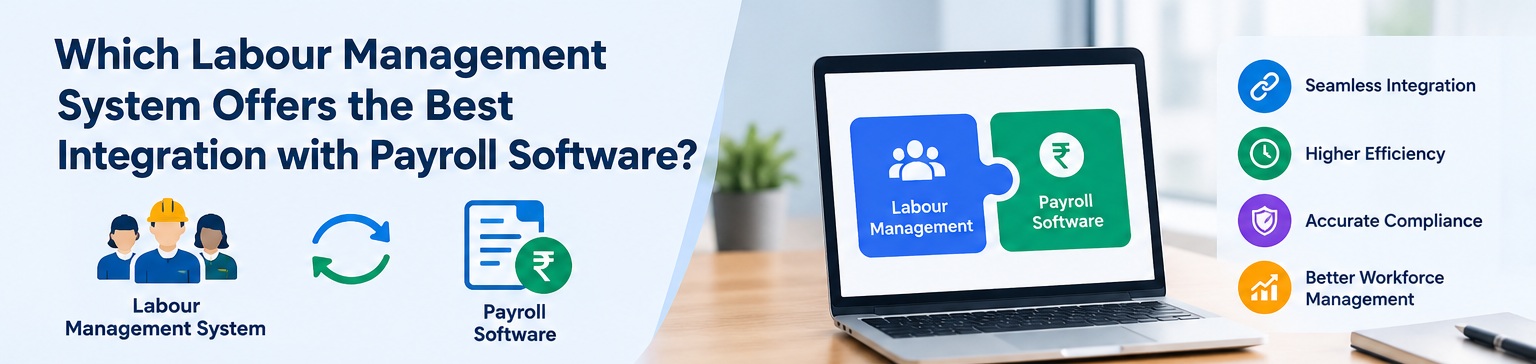
A Labour Management System with Payroll Integration connects workforce activities with payroll processes through a digital workflow.
Employee information, attendance, shift details, leave, overtime, and other relevant records can be captured and maintained in the labour management system. The required information can then be transferred or synchronized with payroll software for salary processing, depending on the integration method supported by the platform.
This process can reduce repetitive data entry and help HR and payroll teams work with more consistent employee information.
What Are the Key Features of a Labour Management System?
The features available can differ between platforms. However, an effective labour management solution may include:
- Employee management: Maintains centralized employee and workforce information.
- Attendance tracking: Records employee attendance and working hours digitally.
- Shift management: Helps create and manage different shifts and work schedules.
- Overtime management: Records additional working hours for relevant payroll processes.
- Leave management: The system manages personnel leave data while tracking their remaining leave days.
- Payroll integration: The system links all staff details needed to process payroll operations.
- Employee self-service: Let staff members view their attendance records, leave information and their payroll data in areas that support this functionality.
- Reporting and analytics: Produces reports that show attendance details together with overtime information and workforce distribution data and related statistics.
- Multi-location management: Supports workforce management across offices, branches, plants, or work sites.
- Role-based access: Helps control access to employee and payroll-related information.
- HRMS integration: Connects labour management with broader HR processes where supported.
These features can help organizations establish a more structured approach to workforce administration.
5 Best Labour Management Software With Payroll Integration
Businesses have different workforce structures, attendance requirements, shift patterns, and payroll processes. Therefore, the right labour management software depends on the organization’s specific requirements, workforce size, payroll setup, integration needs, and reporting requirements.
Below are five labour management and HR software solutions that businesses can consider.
1. Savvy HRMS
Savvy HRMS is an integrated HRMS platform designed to help organizations manage employee and workforce processes through a centralized system. With 20+ powerful HR modules, Savvy HRMS brings together important HR functions such as employee management, attendance, leave, payroll, recruitment, onboarding, performance management, travel and expense, and employee separation.
For organizations looking for a Labour Management System with Payroll Integration, Savvy HRMS can help connect workforce information with payroll processes. Attendance, shift, leave, overtime, and employee information can be managed within the HRMS environment, helping HR teams reduce repetitive data handling and maintain more organized workforce records.
Key Features of Savvy HRMS
- 20+ HR Modules: Covers major HR processes through a centralized platform.
- Attendance Management: Manages employee attendance, shifts, rosters, working hours, and attendance-related processes.
- Overtime Management: Helps track and manage overtime information for payroll processing.
- Leave Management: Manages leave policies, balances, approvals, carry-forward, encashment, and comp-off.
- Payroll Management: Supports salary structures, deductions, increments, loans, advances, reimbursements, and payroll processing.
- Statutory Compliance: Supports payroll-related requirements such as PF, ESIC, UAN, and other applicable processes.
- Employee Management: Maintains centralized employee information and records.
- Employee Self-Service: Helps employees access relevant HR information and perform supported HR activities.
- Reports and Analytics: Provides workforce, attendance, payroll, and other HR-related reports.
- Integrated HRMS: Connects workforce management with other HR functions through a unified platform.
2. Darwinbox
Darwinbox is an HR technology platform that provides tools for employee management, workforce administration, attendance, payroll, and other HR processes.
Key Features of Darwinbox
- Employee and workforce management
- Attendance and leave management
- Payroll capabilities
- Employee self-service
- HR reporting and analytics
3. Keka
Keka is an HR and payroll platform offering employee management, attendance, leave, shift management, overtime, and payroll-related capabilities.
Key Features of Keka
- Attendance and time tracking
- Shift and overtime management
- Leave management
- Payroll processing
- Employee management
4. Zoho People
Zoho People is an HR management platform that provides employee information management, attendance, leave, time tracking, and other HR functions.
Key Features of Zoho People
- Employee management
- Attendance tracking
- Leave management
- Time tracking
- Payroll integration
5. Pocket HRMS
Pocket HRMS is an HRMS and payroll platform designed to manage employee and workforce processes, including payroll, attendance, leave, shift management, employee management, and timesheets.
Key Features of Pocket HRMS
- Payroll Management
- Attendance Management
- Shift Management
- Overtime Management
- Employee Self-Service
How Does Labour Management Software Integrate With Payroll Management Software?
The integration process generally involves connecting workforce information with the organization’s Payroll Management Software.
For example, attendance records can provide information about the days worked by employees. Shift and working-hour information can provide relevant inputs for calculating overtime. Leave information can also be considered during payroll processing according to organizational policies and system configuration.
Once the relevant information reaches the payroll system, it can be used for salary calculations, applicable deductions, payslip generation, and payroll reports.
The exact process depends on the software. Some platforms may offer direct integration, APIs, automated data synchronization, or other connectivity options.
Therefore, organizations should examine the available Payroll Software Integration options before selecting a labour management platform.
What Are the Benefits of a Labour Management System With Payroll Integration?
Integrating labour management with payroll can provide several operational benefits.
Some of the key benefits include:
- Less manual data entry: Reduces the need to repeatedly enter employee and attendance information.
- Improved data consistency: Helps maintain more consistent workforce and payroll records.
- Faster payroll processing: Makes relevant attendance and work-related data available for payroll calculations.
- Better overtime tracking: Provides organized records of additional working hours.
- Simplified administration: Reduces repetitive coordination between HR, administration, and payroll teams.
- Centralized employee information: Keeps workforce information in one structured digital environment.
- Better reporting: Helps generate workforce, attendance, overtime, and payroll-related reports.
- Improved employee experience: Provides employees with direct access to relevant information which enhances their overall experience at work.
- Better workforce visibility: Helps managers and HR teams understand attendance and labour utilization.
The value of these benefits increases when organizations expand their operations which create more complicated workforce management systems.
Conclusion:
Overall, A Labour Management System with Payroll Integration allows organizations to link their workforce management operations directly with their payroll systems through a single digital process.
Businesses need to transition from their current practice of keeping separate employee data and attendance, shift, overtime, leave and payroll records into a unified system which enables better workforce information management.
Organizations should choose the appropriate solution based on their number of employees, their business sector, their work schedule patterns, their payroll operations, their system compatibility, their data analysis requirements, their ability to grow and their data protection standards for information.
The digital transformation of HR and workforce operations at businesses needs Payroll Management Software to join forces with Labour Management systems to create better organizational management of employee and payroll information.
Book a free demo of Savvy HRMS today and explore how its integrated HRMS platform can help streamline attendance, shifts, overtime, leave, payroll, and other essential HR processes.